
NovAbyss field notes · 6 minute read
How to choose an aquarium light
Choose an aquarium light by livestock first: coverage and measurements at depth, controls that keep a routine, and a sensible starting schedule.
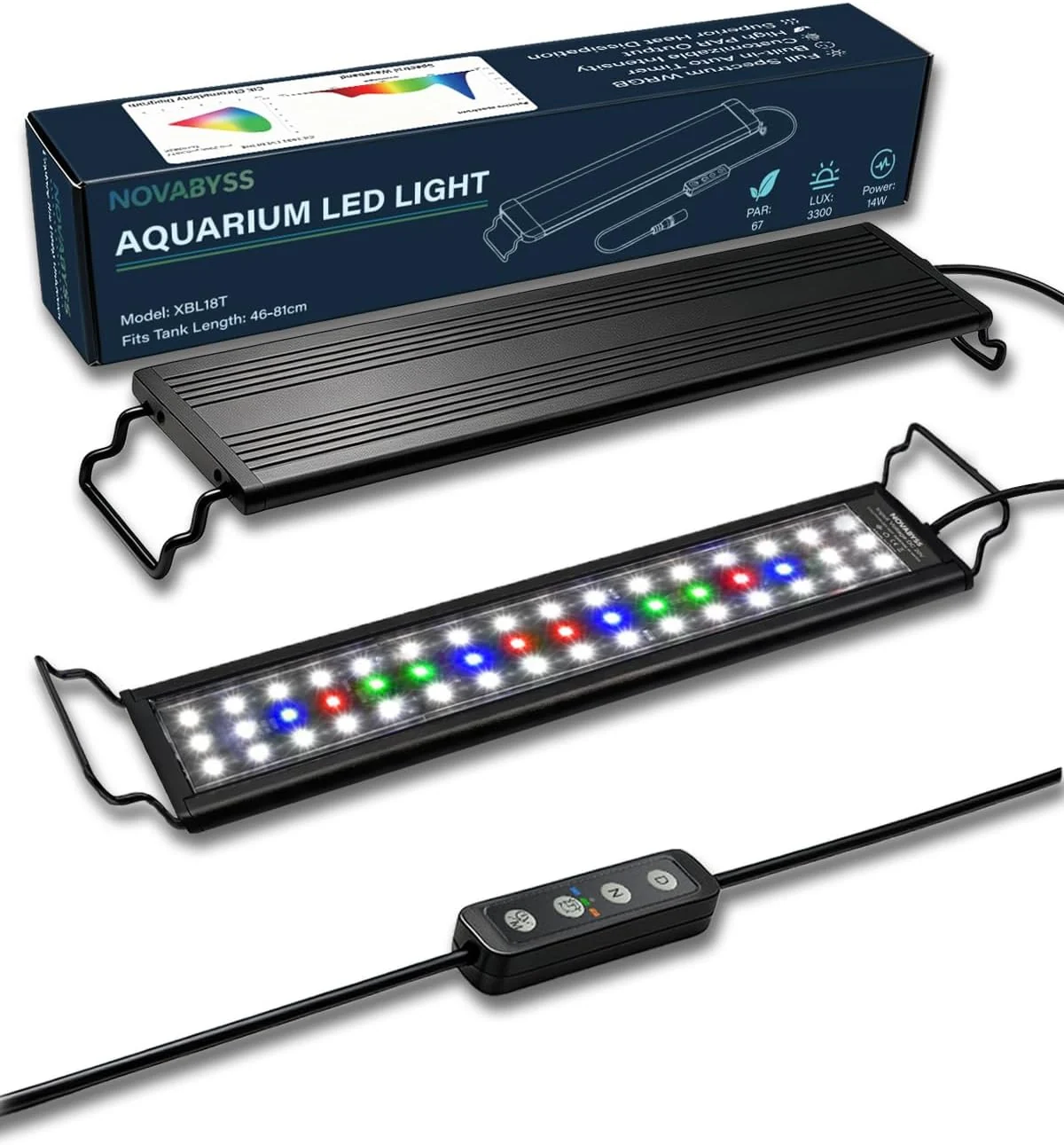
Start with what you want to keep, then choose a light that fits your tank and makes a consistent daily routine easy. A light that looks bright to you may still be unsuitable for the plants or corals beneath it.
Choose for the life in your tank
| Your aquarium | What to prioritize |
|---|---|
| Fish with no live plants or corals | Comfortable viewing, even coverage, adjustable brightness and a reliable timer. Provide shaded areas suited to your fish. |
| Freshwater with low-light plants (easy live plants) | A light intended for planted aquariums, with adjustable output and enough coverage at plant level. Check the needs of the actual plants you choose. |
| High-light planted aquarium (demanding setup) | Light output matched to plant species, tank depth, CO₂ supply and nutrients. More light can make the overall care routine more demanding. |
| Reef aquarium with corals | A reef light with suitable spectrum and measured output at coral depth. Match it to the corals you plan to keep and acclimate them to changes. |
Compare useful information
Watts describe electrical power use. They do not tell you how much useful light reaches a plant or coral. A “full spectrum” label also does not establish that a fixture suits every aquarium.
For plants and corals, ask for light measurements at relevant depths. Aquarium “PAR readings” usually refer to photosynthetic photon flux density, expressed in µmol/m²/s. Compare measurements only when mounting height, depth and output settings are stated. A coverage map is more useful than one bright reading directly under the center.
There is no single PAR target for every planted or reef tank. Use the requirements of your chosen species. If a manufacturer provides no measurements, ask for a specific recommendation for your tank dimensions and livestock rather than relying on a tank-length label alone.
Check fit and coverage
Measure tank length, front-to-back width, water depth and rim thickness. Confirm the bracket range and clearance around the lid and filter. A light can fit across the top yet leave the ends or bottom too dim. Taller tanks and wide layouts deserve particular attention.
Choose controls you will actually use
- A timer keeps the day consistent. Check whether one is built in or whether a compatible external timer is needed.
- Dimming lets you adjust output without replacing the fixture. Check whether brightness and color channels can be saved.
- Confirm what happens after a power outage. Some lights resume a schedule; others reset or stay off.
- If the light uses an app, check whether basic daily operation continues without your phone or an internet connection.
Start with a manageable schedule
For a newly planted freshwater aquarium, about six hours of light per day is a practical starting point. Tropica recommends ↗ six hours for the first three weeks, followed by gradual increases up to eight hours. This is guidance for starting planted tanks, not a universal schedule for every aquarium.
Set an appropriate brightness for your plants and fixture; a percentage setting is not comparable across different models. Keep a dark period overnight. Decorative blue light is still light and should not run all night by default.
Check plant growth, algae and fish behavior over time. Change one setting at a time when the aquarium is otherwise stable, and record the old and new values. If algae increases, review duration, intensity, nutrients and maintenance together instead of assuming the tank needs a different color. For corals, follow species-specific requirements and the fixture’s acclimation guidance. Do not apply the freshwater starting schedule as a reef-lighting prescription.
A simple buying example
For a freshwater tank with fish, Anubias and Java fern, begin by comparing dimmable planted-tank lights that cover the tank and have a dependable timer. You do not need to choose the strongest fixture available. For a deeper tank with demanding carpeting plants, request measurements at the substrate and plan the CO₂ and nutrient routine before buying.
Before you order
Confirm the mounting range, power supply, moisture rating, cable reach and return policy. Splash resistance does not mean a light can be submerged. Install it as directed and keep electrical connections dry.
Need help narrowing the options? Share your tank dimensions, plant or coral list, and a photo of the top of the aquarium with NovAbyss →